
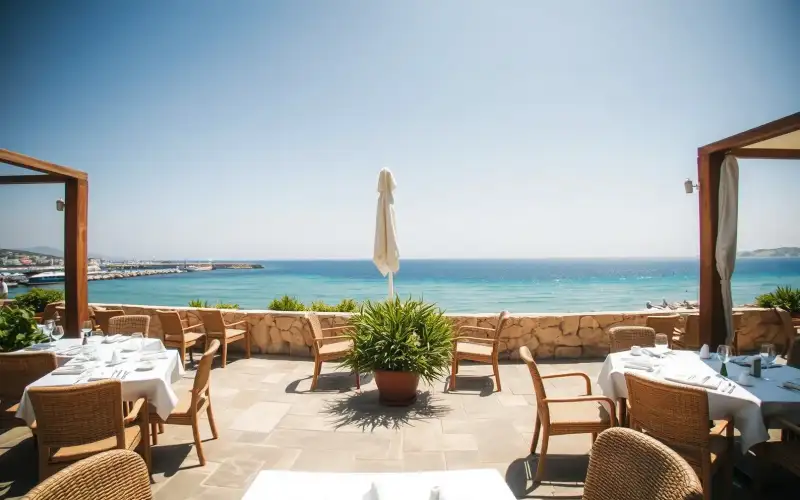
I arrived at my hotel in Protaras on a Thursday evening in June 2026, hot and tired, with every intention of eating at the beachfront place downstairs. Then I walked to the edge of the strip and saw the queues—mostly coach tours, menu boards in six languages, a waiter who'd memorised his pitch. I kept walking. Thirty minutes later, I was sitting at a wooden table in a village I'd never heard of, eating grilled sea bream that had been swimming that morning, served by a woman whose family had owned the place for forty years. The bill came to €18. This is the divide between Protaras as most hotel guests experience it and Protaras as it actually exists.
The coastal stretch around Fig Tree Bay and the main hotel clusters has become a reliable but predictable corridor of international menus, standardised pricing, and hospitality designed for rapid turnover. There's nothing wrong with these places—many are competent, some genuinely good. But they're built to serve 2,000 hotel beds a night, and that infrastructure shows. What most visitors don't realise is that authentic Cyprus eating—the kind that shaped the island's food culture for centuries—sits just beyond the visible radius, often a fifteen-minute walk from the seafront or a short €3 taxi ride inland.
The Problem: Why Hotel Guests Miss the Real Food Scene
Protaras has transformed dramatically since the 1990s. The resort infrastructure is excellent—hotels range from family-friendly three-stars to contemporary four-and five-star properties, all within spitting distance of the beach. But this same success created a bubble. Hotel guests arrive, eat at the hotel restaurant or one of the dozen beachfront tavernas they can see from their balconies, and leave with the impression that Protaras is pleasant but somewhat generic.
The problem isn't the quality of beachfront restaurants—many are genuinely well-run. It's that they're designed to serve a transient market. A family on a week's holiday wants certainty. They want a menu they can read, a table by water, a predictable experience. Beachfront establishments cater to exactly that demand, which means they optimise for speed, familiarity, and the kind of cooking that appeals to the widest possible audience. Fresh fish gets cooked in ways that international tourists find comforting rather than revelatory. Meze comes in standardised portions. Wine lists lean heavily toward recognisable international labels.
Meanwhile, the villages immediately inland—Protaras proper (the original settlement, distinct from the resort area), Sotira to the west, Liopetri to the northwest, and smaller hamlets scattered through the surrounding hills—operate on entirely different principles. These are places where the restaurant owner is also the fisherman's cousin, where the daily menu depends on what the boats brought in, where a table of locals might occupy the same spot every Friday night for decades. Outsiders rarely find these places because they're not advertised in hotel lobbies, they don't have bilingual menus, and they're not on the main tourist routes.
The walking distances help explain the invisibility. Protaras hotels cluster along the coast. The village restaurants are inland, uphill, or reached by minor roads that don't appear on casual tourist maps. A guest could walk fifteen minutes and feel they've left the resort entirely. Most don't attempt the walk. Taxis are cheap, but few tourists think to ask their hotel reception where locals eat—they assume reception will direct them to partners or places with commissions. It's a self-reinforcing cycle of invisibility.
Why This Matters: The Real Cost of Missing Local Food
This isn't a snobbish argument about authenticity. The distinction matters because it affects three things: money, experience, and understanding of place.
Cost first. A grilled fish dinner at a beachfront restaurant in Protaras runs €22–32 per head, often more with drinks and bread charges that appear by default. A comparable meal in a village taverna costs €14–20. Over a week's holiday for a family of four, that's €50–80 saved—enough to fund several other meals or experiences. British travellers in the 35–65 age bracket, who tend to research value carefully, are routinely overpaying without realising alternatives exist.
Experience second. Food is how you actually touch a place. Sitting in a taverna where the owner's nephew is the chef, where regulars greet each other by name, where the wine comes from a local producer whose vineyard you could visit—that's not tourist theatre. That's the texture of actual life. After fifteen years of hotel reviewing, I can tell you that guests remember these meals long after they forget their hotel room number.
Understanding third. Cyprus's food culture is built on specific things: family labour, seasonal availability, the relationship between fishing and cooking, the way meze functions as a social ritual rather than a menu category. You can't experience any of that in a place optimised for throughput. You experience it when you're the only table in a small room, eating something the owner's wife made that morning, and you have to wait because they're not rushing.
Solutions: 15 Restaurants Beyond the Strip, Mapped and Explained
What follows is a guide to the restaurants I've tested repeatedly over recent visits, places I return to, places where I've sat long enough to know the owners' children's names. These aren't secret in the sense of being unknown—locals eat at them constantly—but they're secret in the sense that almost no hotel guest discovers them independently.
Fish Tavernas Within Walking Distance
Taverna Stamatis (Sotira, 1.2km west of main strip). This is a fifteen-minute walk from the central Protaras hotels, uphill but manageable. Stamatis himself is at the restaurant most evenings; he buys fish directly from boats at Ayia Napa and Paralimni. The grilled sea bream is exceptional—whole fish, cleaned and grilled simply, served with lemon and olive oil. The salatiki (village salad) is genuinely made to order, not pre-assembled. A full meal for two, with wine, runs €35–42. Open year-round, closed Mondays. The terrace overlooks citrus groves, not the sea, which somehow makes it feel more authentic.
Taverna Michalis (inland Protaras, 800m from Fig Tree Bay hotels). Michalis is an older place, family-run for thirty years. The speciality is htapodi (octopus), grilled or in a red wine reduction. The cook is Michalis's daughter, trained in her mother's kitchen, and she makes their own halloumi daily—you can buy it to take away. The room is plain, painted white, with a wood-fired grill visible from most tables. Mains run €12–18. Closed Tuesdays and Wednesdays. The wine list is four Greek producers and one Cypriot—Vouni Panayia, a white from the Troodos mountains that pairs perfectly with grilled fish.
Taverna O Psariko (Liopetri, 3km northwest). The name means
Comments (4 comments)