
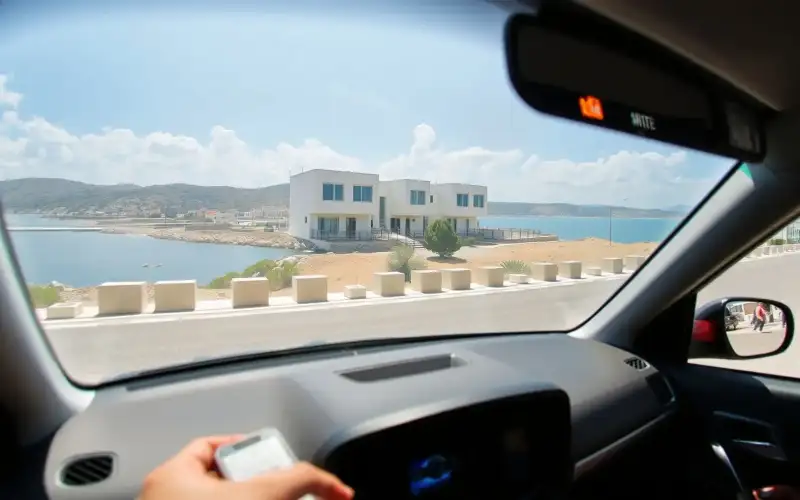
Last April, I watched a British couple spend their first morning arguing in the Paphos Harbour car park. Their rental Hyundai was wedged between a delivery truck and a tour operator's minibus. The husband was convinced he'd booked a space at their hotel. The wife was reading the confirmation email aloud, proving he hadn't. They'd paid €38 for the car that day alone and hadn't left the resort yet.
That scene crystallises the car hire question I hear constantly from guests planning Cyprus trips. Do you actually need one? The honest answer: it depends entirely on your itinerary, your nerve, and your budget.
The Case Against Renting (And It's Stronger Than You Think)
Let's start with the brutal economics. A compact car in high season 2026 runs €25–45 daily through major firms. Add comprehensive insurance (essential, trust me), and you're at €35–60 per day. Petrol for a week exploring the island costs another €40–50. Parking at hotels—often not included despite what you assume—adds €8–15 nightly. By the end of a two-week stay, you've spent €500–700 on transport alone.
That money buys a lot of alternatives.
The driving itself presents real friction for British visitors. Yes, Cyprus drives on the left, which feels familiar until you realise the roads aren't. Paphos has no clear street names. Larnaca's ring road changes designation three times. Road signs vanish without warning. I've seen sensible 55-year-old accountants from Surrey genuinely lost in Nicosia after taking a wrong turn near the old city walls—twice.
Speed cameras are aggressive and poorly marked. Fines start at €200 and rental firms charge you €30 admin fees on top. Parking enforcement in Limassol is ruthless; I watched a car get ticketed within eight minutes of the owner nipping into a café. Most hotel car parks aren't monitored, but public spaces are.
Then there's the stress factor. Driving a left-hand car on unfamiliar roads in heat, navigating villages where three cars cannot pass simultaneously, dealing with local drivers who treat roundabouts as suggestions—it exhausts people. I've had guests tell me they spent their holiday tense and tired rather than relaxed.
When Taxis and Transfers Actually Win
For guests staying in resort clusters—Paphos Old Town, Limassol seafront, Ayia Napa—a hire car is often unnecessary theatre.
Taxis are everywhere and cheap by British standards. A journey from Paphos airport to the town centre costs €25–32. The same trip by rental car costs €2 in petrol but €10 parking at your hotel and €38 daily rental. The maths don't work. Within resort areas, taxis between restaurants, bars and beaches run €6–12. You'd spend more on parking than the journeys themselves.
Hotel transfers are underrated. Most three-star and above properties offer airport pickup for €35–50 return. Yes, it's more than a taxi one way. But if you're not leaving the area, you've eliminated the rental entirely. I've stayed at twelve properties in Limassol alone that include transfers with bookings over seven nights. Guests rarely ask about this because they assume they need independence.
Public buses connect major towns reliably. The OSYPA network in Paphos, EMEL in Limassol, and ΑΜΕΑ in Larnaca run frequent services to beaches and villages. A single journey costs €1.50–2.50. A weekly pass is €15. Yes, buses run late and routes can seem random to newcomers, but they work. I've used them dozens of times without incident.
For restaurant hopping or bar crawls, taxis eliminate drink-driving anxiety entirely. A night out in Limassol with three taxi journeys costs €25–35. Insurance, petrol, and parking for a rental car cost far more, plus the stress of navigating after wine.
Where a Car Becomes Essential (And These Trips Do Exist)
If your itinerary involves villages, wine regions, or multi-region exploration, a hire car changes the equation.
The Troodos Mountains aren't accessible by public transport to any meaningful degree. Visiting Omodos, Platres, or Kakopetria requires either a car or expensive private tours (€80–120 per person). If you want to taste wine in Krasochoria, drive to Akamas Peninsula, or explore the Kyrenia range, you need wheels. These trips justify rental costs immediately.
Couples or small groups splitting costs find cars economical. Four people sharing a €40 daily rental pay €10 each. Add petrol and parking, and per-person costs drop to €15–18 daily. Compare that to private tours at €50–80 per person, and the car wins decisively.
Easter and summer holidays (June–August) see car parks and beaches packed. Having your own transport means you can leave crowded spots and find alternatives. Beaches near Kourion, Coral Bay, or the Akamas are quieter if you drive.
Solo travellers benefit from flexibility. You set your pace, change plans without tour schedules, and discover villages most visitors miss. That freedom has real value, especially for people who've stayed in Cyprus multiple times and want to explore differently.
The Practical Realities of Driving Here
If you do rent, understand what you're getting into. Cypriot driving is aggressive by British standards. Tailgating is normal. Horn use is constant. Roundabouts don't follow strict priority rules—locals assume everyone knows the unwritten hierarchy. Pedestrians cross anywhere, anytime. Speed limits are enforced brutally on motorways but ignored in towns.
Road quality varies dramatically. Motorways between Nicosia, Limassol, and Larnaca are excellent. Secondary roads to villages are potholed and narrow. Gravel tracks to remote beaches will damage a standard rental car's undercarriage. I watched a couple return a car with €400 in damage after attempting a beach track near Akamas.
Petrol stations cluster near towns. If you're driving remote routes, fill up before leaving populated areas. Fuel costs roughly €1.35–1.50 per litre in 2026. A week's driving uses €40–60 depending on distance.
Parking at hotels is the hidden killer. Many properties charge €8–12 nightly despite not mentioning it in listings. Always confirm parking costs when booking. Some smaller hotels have no dedicated spaces—you park on the street and hope. I stayed at a two-star property in Paphos where guests parked on a hillside road, and two cars were broken into in one week.
A Practical Decision Framework
| Scenario | Recommendation | Why |
|---|---|---|
| Staying one location, beach resort focus | Skip the car | Taxis and transfers cover everything; parking costs exceed savings |
| Multi-region trip (north coast, Troodos, south coast) | Rent a car | Public transport can't connect these efficiently; tour costs are higher |
| Wine region or village exploration | Rent a car | Buses don't serve wine routes; private tours cost double |
| Nervous driver or first time abroad | Skip the car | Stress isn't worth the cost savings; transfers and taxis are safer |
| Group of 4+ splitting costs | Rent a car | Per-person cost drops below taxi alternatives |
| Two-week stay, varied itinerary | Rent for 5–7 days, skip the rest | Hybrid approach balances flexibility and cost |
What I Actually Do When I'm Reviewing
After fifteen years and over 200 hotel stays, I rarely rent a car. I use taxis for airport transfers, hire a car for specific trips (Troodos, Akamas, wine country), then return it. For multi-day stays in one location, I use hotel transfers and taxis exclusively.
This approach costs more per day than renting for the full stay, but less overall because I'm not paying parking, petrol, and insurance for days when I'm not driving. It also keeps me mentally fresh—no navigation stress, no parking anxiety, no argument in the Paphos Harbour car park.
If you're visiting Cyprus for the first time and staying in Paphos, Limassol, or Larnaca for a week, my honest advice: skip the rental. Use transfers to the airport, taxis between venues, and book a day trip or two with a tour operator for places you want to see. You'll spend less, stress less, and enjoy yourself more.
If you're returning for a second or third visit and want to explore beyond resort areas, rent a car for 4–5 days, not the full fortnight. Hit the Troodos, drive the Akamas, taste wine in Krasochoria, then return the car and relax at your hotel for the remainder.
The British guests who report the happiest Cyprus experiences aren't the ones who rented cars for their entire stay. They're the ones who chose transport strategically, adapted to local conditions, and didn't treat independence as an obligation.
Car hire in Cyprus isn't about whether you can drive. It's about whether driving serves your actual trip. Most of the time, it doesn't.




Comments (3 comments)